

Escape rooms have become increasingly popular over the years, both with small teams of two and larger teams of up to six or more. We all know they are an exciting and unique way to spend time with friends and family while challenging everyone mentally. However, not all escape rooms are created equal. Some are linear, while others are non-linear. If you’re designing a game, it’s important to understand the differences between these two types of escape room gameplay.
What is Game Flow?
First things first, what is game flow in escape rooms? It’s the way puzzles and tasks are structured and sequenced throughout the game. Think of it as the storyline of your adventure, guiding you from start to finish.
Linear Game Flow: One Path to Victory
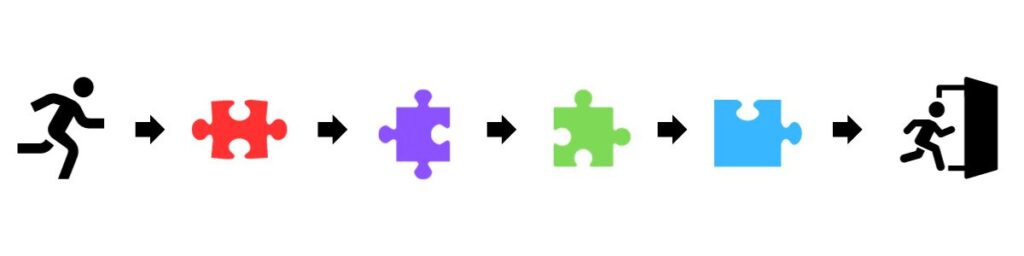
In a linear escape room, the (sequential) path is like a treasure map with a single trail to follow. You solve puzzles one after the other, in a specific order. Each puzzle leads directly to the next, and you can’t skip ahead.
Benefits:
- Clarity and Focus: With a clear sequence, it’s easier to focus without getting overwhelmed. Great for beginners or those who prefer a straightforward approach.
- Team Unity: Everyone works together on the same puzzle, which can strengthen team dynamics and communication.
If it’s just Tina and I playing, we like linear games because it allows us to tackle each puzzle together, and we both want to see all the puzzles in an escape room.
Example: Imagine an escape room themed as a detective story. You find a clue (Puzzle 1), which leads to unlocking a briefcase (Puzzle 2), inside the briefcase is a map to a hidden room (Puzzle 3), and so on. Each puzzle leads to the next.
Non-Linear Game Flow: Choose Your Own Adventure

Non-linear (or open path) escape rooms are like a spider web of possibilities. You have multiple puzzles available to solve in any order. Eventually, they will all lead to the same endpoint.
Benefits:
- Flexibility: Perfect for larger groups! Players can split up and tackle different puzzles simultaneously, making the most of everyone’s strengths.
- Variety and Surprise: These rooms often feel more dynamic and unpredictable, keeping even the most experienced players on their toes.
Example: Think of a space-themed room where you’re repairing a spaceship. One team member is decoding alien languages (Puzzle 1), another is fixing wiring circuits (Puzzle 2), while others are calculating the trajectory for the return journey (Puzzle 3). You’re all working towards the same goal but from different angles.
Multi-Linear Game Flow: Choose Your Path

Multi-linear escape rooms are like highways with multiple lanes. Each lane is a puzzle path that players can choose, yet all these paths are moving in the same direction towards a common endpoint.
Benefits:
- Focused Collaboration: Ideal for larger groups, multi-linear rooms allow players to team up in smaller groups and tackle different puzzles in a coordinated manner, leading to a shared finale.
- Structured Diversity: These rooms provide a balance between guided progression and varied challenges, offering a mix of predictability and excitement.
Tina and I prefer a non-linear game flow or a multi-linear game flow if we are playing with other people.
Example: Picture a creepy mansion where each room reveals a part of the story. One subgroup is solving a linear path of puzzles in the ancient library (Path 1), another is on a path of puzzles in the hidden garden (Path 2), while others are uncovering the history of the portrait gallery (Path 3). Although each subgroup is engaged in a different narrative thread, all are piecing together the mansion’s overarching mystery.
Which to Choose?
Deciding between linear, non-linear, and multi-linear when designing your escape rooms depends on who you want to design for, newbies and small groups or enthusiasts and larger groups. Newbies might enjoy the guided structure of linear rooms, while veterans or larger groups could thrive in the bustling chaos of non-linear or multi-linear scenarios.
But what if you want to cater to ALL groups? The only way to do that is through creative design and/or adaptive difficulty (which will be discussed in a future article). It is possible to put together a game with a multi-linear game flow and create it so that a team of two or novice players can play and finish the game following one path only. But to effectively hide the other paths and still have a complete game would take some very creative designing.
We have played many non-linear and multi-linear games, and though it’s not our favorite type of game flow when it’s just the two of us, we usually still have a great time.
In the end, my personal preference when designing escape rooms is to use a multi-linear game flow. With proper clueing and hinting, first-time players and small groups can have a great time and finish the game, which is really the goal, isn’t it? It also gives larger groups enough to keep everyone engaged the whole time.
