


























What does a typical commercial escape room game cost to put together? (Hold on to your potatoes!) If an escape room business owner does everything themselves (game design, room design and build, and decor), they will usually spend anywhere between $15,000 – $30,000 on one game depending on how much technology there is and how many rooms that game has. (And that would be considered low-cost for a commercial room. Isn’t that crazy?!?)
Now, if that owner decides to purchase a turn-key game from an escape room design and fabrication company and has that company install it, the price can range between $60,000-$125,000. (Ready to take out that loan, yet?)
Of course, if you are someone looking to put together an escape room for your youth and/or family organization. You want it to be fun and look good, but there is NO WAY you have a $125k budget or even a $15k budget to do this (though there are camp programs that can cost over $15k to start – We’re looking at you ropes course, waterfront and crafts shack).
The good news is that you can put together an escape room for $1000 – $5000 (or less).
We know of two summer camp directors who put together fantastic two-room games that have little to no technology, and they only spent around $5,000 for each of their games. Both of these games look fantastic and the kids and families really enjoy them. They were able to do this by utilizing available space very well, using props and supplies they already had, and getting help from staff and/or volunteers. Both have even had outside groups pay to play their games.
Personally, I have put together games for summer camps that ran under $1000 (locks, boxes, props, and basic decor). For the first game I offered at camp, I spent less than $500. It was basic, but the kids really enjoyed it…especially the middle school age.
Could it be done for less? Possibly. It depends on what space you use and what items you already have, can borrow, or can get donated.
So, how DO you put together an escape room that won’t break the bank?
Let’s start at ground zero. You may not be all that familiar with escape rooms. If that’s the case, let me give you a brief description of what an escape room is. (This is an abridged description of Escape Rooms from Peeking Behind the Locked Door – a survey of escape room facilities by Scott Nicholson.)
“Escape rooms are live-action team-based games where players discover clues, solve puzzles, and accomplish tasks in one or more rooms in order to accomplish a specific goal (usually escaping from the room) in a limited amount of time.
The escape room experience starts with the players meeting their game master, who briefs them on what will be happening over the next hour and gives them the rules for the game. If there is a back story, the players may watch a video or be given a passage to read. The door is closed and locked and a countdown clock begins.
Players explore the room, tentatively at first but then more aggressively as time goes on, looking everywhere for clues. There are usually numbers, symbols, or pictures on the walls but no apparent guide to understanding what they are there for. It’s all a mystery.
The first part of the experience is searching through drawers, boxes, pockets of clothing, and underneath and behind everything; well-communicating teams call out what they find and organize things that might go together. At some point, players will discover a puzzle and figure out how it can be solved; some puzzles have directions and others do not.
The solution to one puzzle will lead to something else – it may be a code for a padlock, the starting key for another puzzle, a door that opens to another room, a piece for a meta-puzzle, or it may be a red herring (something that misleads or distracts the team). The group continues to work on puzzles, sharing information about what is found. If they are stuck, there is usually a way for a team to get a hint to help them continue.”
If you’re looking to create a room for a youth or family organization like a summer camp, a recreation department, a private club, a YMCA, a Boys and Girls Club, a church, etc., then your audience is either families or just kids. That’s important. Most (99.9%) commercial escape rooms are not designed for kids, especially those under 12. The puzzles are too difficult. If a game were designed for kids, the puzzles would be too easy for teens and adults. It’s important to know who your audience is before designing your game.
In fact, we have found that it is harder to create games for young kids (under 10) than it is for older kids. So, while you can create an Escape Room experience for elementary school-aged kids, I think it is much more suited for your middle school and high school ages. Also, it can be a great team-building experience, especially if you debrief afterward.
Yes, there are companies, like Breakout EDU, that create escape room-like games for teachers to use in their classrooms, where instead of escaping the room, the goal is to unlock the main box.
You can also find many print-and-play “escape room” games online that are geared towards younger players. However, these are mainly meant for families to print and play at home.
The first thing you’ll want to do is get clear on where you are planning to have your escape room. Will it be in an empty room, the corner of a larger community room, outside in a 10×10 tent, in a cubicle, in a barn, in a trailer, or someplace else?
It’s important to know how much space you have and if it’s already decorated. If it’s already decorated then you’ll want to play into that theme to keep costs low. The less you have to decorate, the lower the overall cost will be.
For example, if you’re using an office you can go with a story that the director had been kidnapped and the group needs to go to his office to figure out what happened.
Or maybe you have space in your barn. Go with a Wild West theme.
Another important reason to start with facilities is to figure out how much space you have. Are you able to use two rooms and create a multi-room game? Can you build a wall in one room to make it two rooms? Is the space really small or is it really big?
Once you know where the game will be, you can visualize the layout as you create the game, and even sketch it out.
Now that you have your space, it’s time to come up with a storyline. After all, having a story makes the game much more interesting than just having a bunch of puzzles and locks that don’t relate to anything.
There are so many storylines and themes you can use. Here are just a few…
Having a theme and a storyline will not only make the experience more memorable, but it will also make it easier and more fun to design.
Of course, decorating a room as though it’s an Egyptian tomb will require a complete redecorating of that room and the purchase of a lot of decorations, unless you already have some. If you have an extra room to run your game and the budget to decorate it then go for it. If not, consider using a space you already have and designing the game around it as I mentioned before.
Keep in mind that it’s not always the goal to “escape the room”. Often, groups are trying to solve a mystery or recover an item. That’s why Adventure Rooms, Mystery Rooms or Puzzle Rooms are good alternative names for these types of games.
Puzzles are what make your theme and storyline into a game. Clues are needed to point the group in the right direction and to help them solve the puzzles.
How many puzzles should you come up with? Figure on puzzles taking your groups 3-5 minutes to solve and go on to the next one. Therefore, if you are designing a 60-minute linear game, you’ll want to come up with an average of 15 puzzles. That may be too many or not enough depending on the difficulty of the puzzles and the age (or ability) of your players.
If you need ideas of puzzles, check the blog. I also co-wrote a book called 101 Puzzles for a Low-Cost Escape Room.
Clues and puzzles can be in a variety of forms. Keep in mind that we are trying to keep the cost low for your camp, so the clues and puzzles I mention are not electronic or expensive to add to your game.
A few examples are:
Pencil Indentations
Using a variety of puzzles and clue-delivery systems is important in a game. They should also fit the scenario. You wouldn’t have a video recording if the game is set in the Wild West.
If you are creating a game for larger groups (8-12 players – I wouldn’t go larger than that), you may want to consider multiple paths.
What are paths?
A typical escape room game is linear, one path, meaning that one puzzle leads to the next. In a linear game, the whole group solves one puzzle and then moves on to the next. This is fine for groups of 2-6 players. For larger groups having multiple linear paths would be better. Of course, that means you need to come up with nearly double the amount of puzzles.
Or you can go with a non-linear format. This is where puzzles can be solved in any order. This format can feel a little chaotic and can really confuse players if not designed properly.
Again, I have not included electronic props like Arduinos and software. I also have not included any magnetic props. However, there are still a lot of supplies you will need.
Here is an example list:
You have your space, theme and story, and a list of puzzles and props you want to use. Now it’s time to plan out the game.
We like to use sticky notes and a blank wall to help us design a game. Each sticky note has a different puzzle or task written on it. Then we arrange them in the order of how we want the game to go. This is a great way to help visualize the game.
Once we have the puzzles and the flow worked out, we begin to sketch out the room(s). We want to know where everything is going to be placed.
After that’s complete, the actual “build” of the room(s) begins.
Success Rates of commercial Escape Room games vary. Some are very difficult and the success rate of groups attempting to “escape” or solve the mystery can be as low as 10%. The success rate of other games can be as high as 80%, but that’s rare. Some commercial Escape Room businesses are now trying to get a 100% success rate by using adaptive difficulty where they are able to change the difficulty before the game starts or on the fly during the game electronically. They also will help teams along by giving them helpful nudges when needed. My recommendation would be to aim for an 80% success rate.
Your room should be difficult enough that not every group will finish in the allotted time (you can always give them more time or more hints), but easy enough that they will be making continuous progress. If you need to make your game more difficult, add more puzzles. Want to make it easier? Eliminate a few puzzles or make some of them easier to solve.
I understand that with kids we feel that everyone should succeed, but there are a lot of lessons that can be learned from failing or running out of time before you hit your goal. If you’re determined to ensure success with every group, add a leaderboard to show the top 3-10 teams/times. This will give the players something to strive for.
When your game is ready, you’ll need to play test it. Find families, staff or friends to play the game and give you feedback. You might learn that you need to add time or eliminate some puzzles. Or that a puzzle you thought was super easy is actually very difficult for everyone else. You may also find that you’re missing a key element or need better signposting.
There are so many things to consider when creating a good Escape Room experience. We know that we’ve only given you a taste of what is involved, but to spell out everything in detail would take a book. It just so happens that I have written a book that walks you through step-by-step on how to create a low-cost game. It’s called How to Create a Low Cost Escape Room for Camps, Youth Groups and Community Centers.
I hope you’ll decide to create an escape room for your audience. There are so many benefits in playing escape rooms, especially for young people.
However, there are also alternatives to escape rooms, like Mystery Trails, Escape Bags, and Puzzle Races.
Let me know in the comments how many (if any) escape rooms you’ve played. Also, feel free to ask any questions you may have.

Large Group Table (Escape Room-Style) Games are for…well…large groups.
Here’s the breakdown.
Groups sit at their own tables. Most of what they need for the game, if not everything, is on their table (intro, puzzles, clues, etc.). Groups are not only looking to finish the game, but often they are trying to finish before the other groups.
There are a couple of ways these games can be set up.
1. Everything is on the table including minimal props, laminated papers, writing paper, and locked boxes. The group plays the game together. Occasionally, one of the players may need to go to a community table or take a look at a poster on a wall to get more info, but for the most part, everyone stays at the table. When the game is complete, the group will have a code to open a locked box that is in the front or middle of the room.
2. Alternatively, at the front of the room are multiple locked boxes that are numbered. Teams start with a packet at their table. The packet contains info and a puzzle or two. When they complete it, they have the code to open one of the boxes at the front of the room. When they open the box, they take their next packet and re-lock the box for the next group. They take that packet back to the table. When that one is complete, they have the code to open the next box. The first group to open the last box, wins.
For a large group table game, you can create your own, purchase a specific large group (or mega) escape room-style game (there are a few out there), or if you want to go the inexpensive route, purchase a print-and-play game on Etsy.
The advantage of a game like this is that it engages big groups. It can be an all-camp activity, a family community event, a school event, or a corporate event.
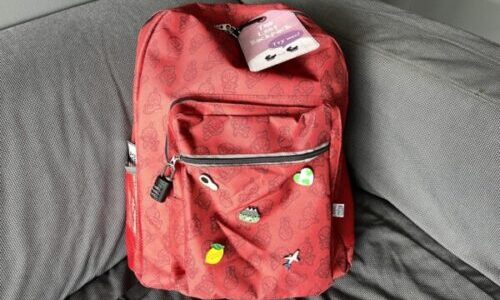
What are Escape Bags?
An escape bag is basically an escape room style game…in a bag. Like an escape room, there is a theme and storyline, some puzzles, and an objective.
For example, Alex’s backpack is a school bag.
Storyline: Next week Alex is going with some friends to play an escape room. So Jack, Alex’s best friend, thought it would be clever to lock up Alex’s backpack with some puzzles to get Alex’s puzzle brain working for their game next week. The problem is, that Alex has a test in 30 minutes and his pencil is locked up. If Alex doesn’t have a pencil, his unforgiving teacher is going to give him detention.
Alex’s backpack has seven locks and takes players usually 20-30 minutes to complete. It’s great for 2-4 players, but can easily engage a larger group, as well. We have used this particular game as a lobby game at a commercial escape room company. Players that would check -in early for a game would often play the backpack. We got a lot of positive feedback on the game.
There are a lot of different types of bags you can make a game out of besides a school backpack…hiking pack, purse, food delivery bag, diaper bag, briefcase, luggage, gym bag, and even a fanny pack.
Escape bags are great for:
If you were to create an escape room bag, what theme or storyline would you use?

So you like the idea of an escape room, but you want the kids to be outside. Then MYSTERY TRAILS may just be what you’re looking for.
A Mystery Trail is an outdoor game of puzzles. The group is given a sheet or booklet with all the clues and an answer sheet. The group starts at a specific spot and reads the first clue on where to go next. When they get to the next spot, they must solve a puzzle. And so it goes; the group moves along the path or trail solving clues and puzzles until the end.
There are several ways you can set up the objective and answer sheet of a Mystery Trail. The length of time is dependent on the number of puzzles and their difficulty.
Diffuse the Bomb
In this Trail, the answer sheet has four columns. Each column has rows of either one number or one letter each. When a group finds a letter that a puzzle has revealed, they mark it off on the answer sheet. At the end, there should be one letter or number per column left unmarked. Those four letters or numbers are the code to “diffuse the bomb”.
Who Done It?
This is a fun one. It;s sort of like the game Clue. The group is trying to determine who committed the crime and what weapon they used. The answer sheet has pictures of all the suspects and weapons. As they solve the puzzles, they are given either the name of a suspect or a weapon. These are the ones that were not involved so they can be checked off on the list. In the end, only one suspect and one weapon will not be checked off, and now they know Who Done It and with What.
You can make this kid-friendly by making the suspects cartoon animals and the weapons silly things like a super soaker. The storyline could be something like, “Who stole the cookies from the cookie jar?”
Buried Treasure
Who doesn’t love treasure? In this variation, the answer sheet is a map with Xs marking various spots that have names (towns, trails, farms, etc.) associated with them. Puzzles that are solved along the trail give names of places where the treasure is not. The location that is not marked off at the end is where the treasure is “buried”.
Here are some ways to use Mystery Trails.

Puzzle Races are a competitive activity or event that can easily be put together in any space, indoors or out, for any age.
There are a few ways to do a puzzle race.
1. An identical series of puzzles are laid out for each team. Players go from one puzzle (or locked box) to the next until all of them are completed.
2. The facilitator is stationed at a specific spot. Each team assigns a runner. That runner goes up to the facilitator to get their first puzzle then runs back to the team to solve it. Once it’s completed, the runner of that team races back to the facilitator to give them the solution/answer and get their next puzzle. The first team to complete all 10 puzzles, wins.
3. Puzzles are set up around the facility (camp, church, park, club, etc.). Each team starts at a different puzzle and works their way around to each one. So let’s say there are 10 puzzles (1-10), and 3 teams. One team starts at puzzle one, the next team starts at puzzle 3, and the last team starts at puzzle 7. As each team completes their puzzle, they get the code to unlock the box at the next station. They unlock it, get their next puzzle and lock the box up again for the other teams to open.
You can use any type of puzzle. They don’t have to follow a theme or storyline. That is the nice thing about puzzle races; they are easy to design and set-up. Yet, they still provide the benefits of an escape room game (fun, communication, cooperation, cognitive thinking, etc.).
If you need some help coming up with puzzle ideas, check out my book 101 Puzzle Ideas for Low-Cost Escape Rooms.